How did the Academy deal with mental health issues in the 19th century? Below is an 1854 note from USMA Surgeon John M. Cuyler, M. D. about the mental and physical health of Cadet William Eugene Webster. It is not addressed to anyone, so presumably it’s a memorandum for record. If definitely shows a concern for both Webster’s physical and mental health.
Certificate of ill health in the case of Cadet W. E. Webster U. S. Mil. Acady.
Cadet W. E. Webster from repeated attacks of acute dysentery has become so depressed and nervous, that he cannot possibly attend to his Academic and Military duty.—
He tells me, that some time before entering the Academy, he suffered from a similar attack of nervousness and for a time almost lost his reason.—Believing, that freedom from all duty together with a change of scene and diet will restore him to health, I recommend, that a leave of 3 or 4 months be granted to him. Cadet Webster will moreover have an opportunity of consulting his parents and friends as to the propriety of resigning, which he seems to consider necessary.—
Jno. M. Cuyler
Surgn USAWest Point N. Y.
Feby. 15th 1854.
Cadet William Eugene Webster was related to Robert E. Lee’s wife. His mother and Mary Anna Custis Lee had the same grandmother. Robert E. Lee was the U.S.M.A. Superintendent at this time, so perhaps Webster got some extra consideration. In any case, the young man left the Academy and did not graduate. His 1854 resignation is in the Yale Archives. Despite being from Connecticut, Webster joined the Confederate army because of the family connection to Lee. Union troops put four bullets into Webster at the Battle of Gaines' Mill in June, 1862.
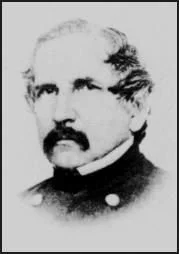
John Meck Cuyler, MD
Source: Wikipedia
Surgeon John Meck Cuyler was a well-known and long-serving Army doctor. Despite being a Georgian, he honored his oath and served in the Union Army. Contrary to many online sources, he was not a West Point graduate. Books say he got his degree from Athens College. This is actually the University of Georgia and records say he graduated in 1829. The college had an associated medical school in Augusta, known as the Medical College of Georgia, now Augusta University. But, their first graduates were in 1832, so perhaps Cuyler was one of the early graduates as his Army career begins in 1834.
Cuyler is best known for his service at Gettysburg. While operating on a patient with gangrene at the II Corps field hospital, he cut himself with his own scalpel. Realizing that he could get the patient’s infection and pass it along to the wounded, Cuyler had his own finger amputated!
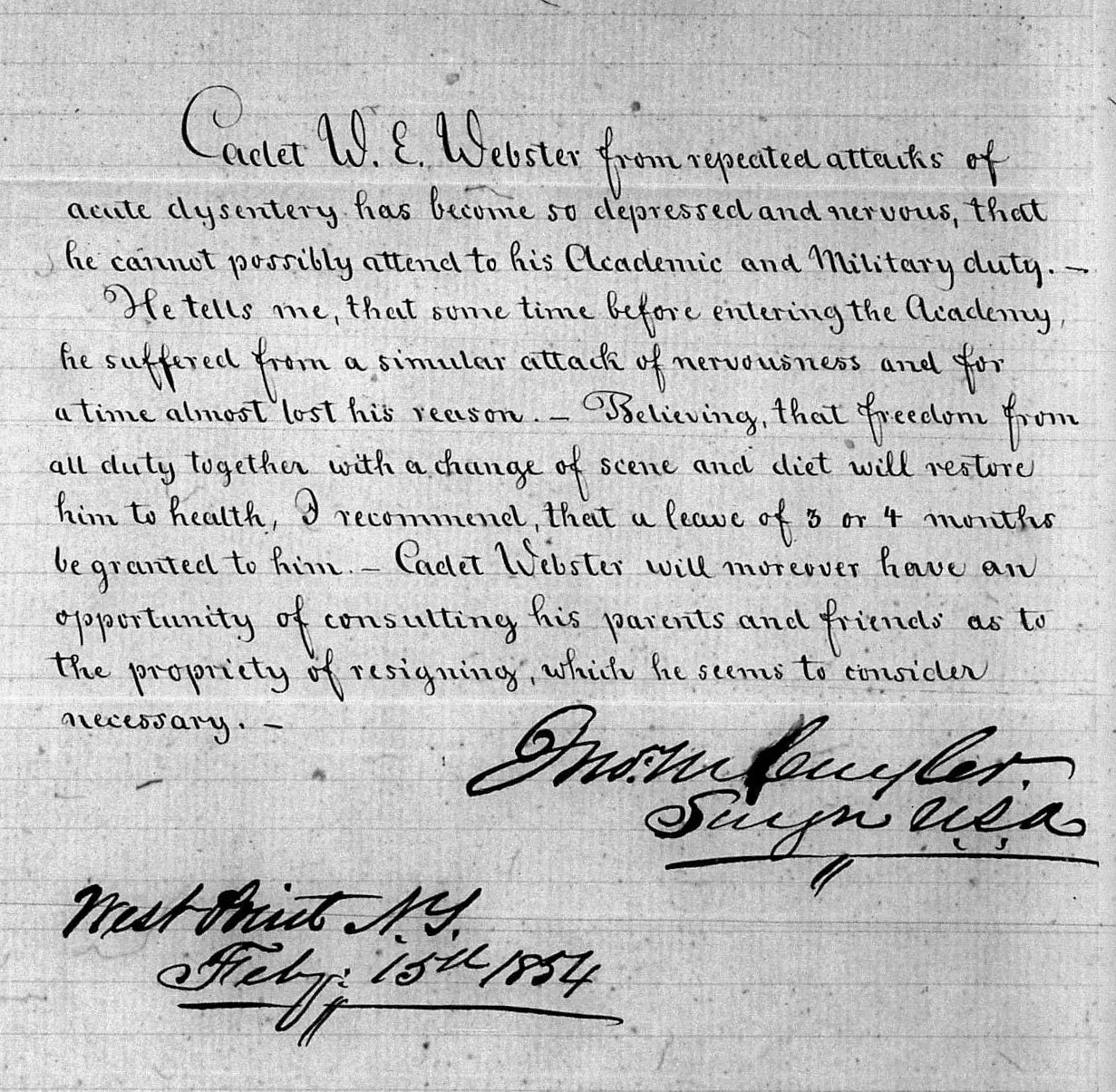
A microfilm photo of Cuyler’s original 1854 note. Source: National Archives