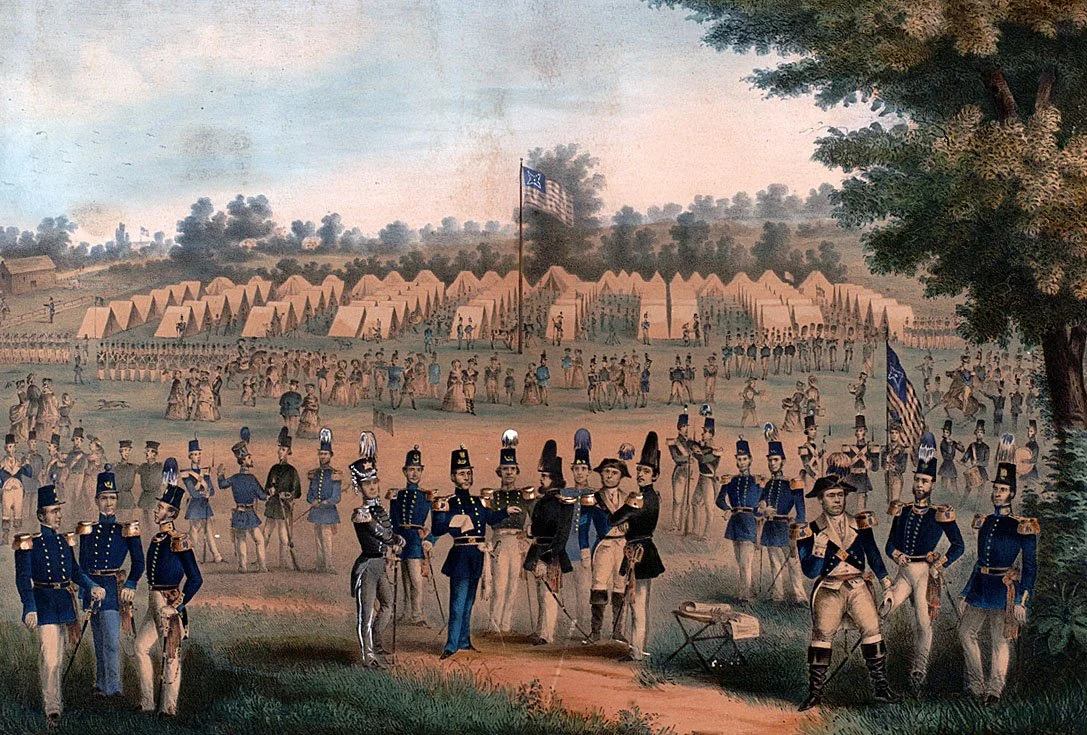
“Encampment of the ‘Hudson Brigade’ N.S.J.M.,” 1852. The Wright Independent Rifles were part of this New Jersey militia unit. The story here took place a year before this gathering. Source: Smithsonian, Harry T. Peters "America on Stone" Lithography Collection
In August of 1851, the Wright Independent Rifles of Jersey City decided to go on a boat excursion with some guests up the Hudson to West Point. New Jersey had a volunteer militia, and the Wright Independent Rifles were part of the Hudson Brigade of North Jersey. They boarded the steamer Hudson and arrived at Cozzens’s Landing in Buttermilk Falls, now Highland Falls, looking for a good time. By one account, they were joined by other military units, including New York Volunteers.
It was called Cozzens’s Landing—or “Cozzens’ Landing” or “Cozzens’s Dock”—because it was the dock for the large Cozzens’s Hotel located high on a cliff above the River in Buttermilk Falls. A later version of the hotel became Ladycliff College, and the is now the site of West Point’s Five Star Inn, an aspirational name. But Cozzens’s Hotel was the real deal. William B. Cozzens had been the respected proprietor of the West Point Hotel on Academy grounds before going into business for himself. He had also managed the American Hotel at 229 Broadway in New York City near City Hall.
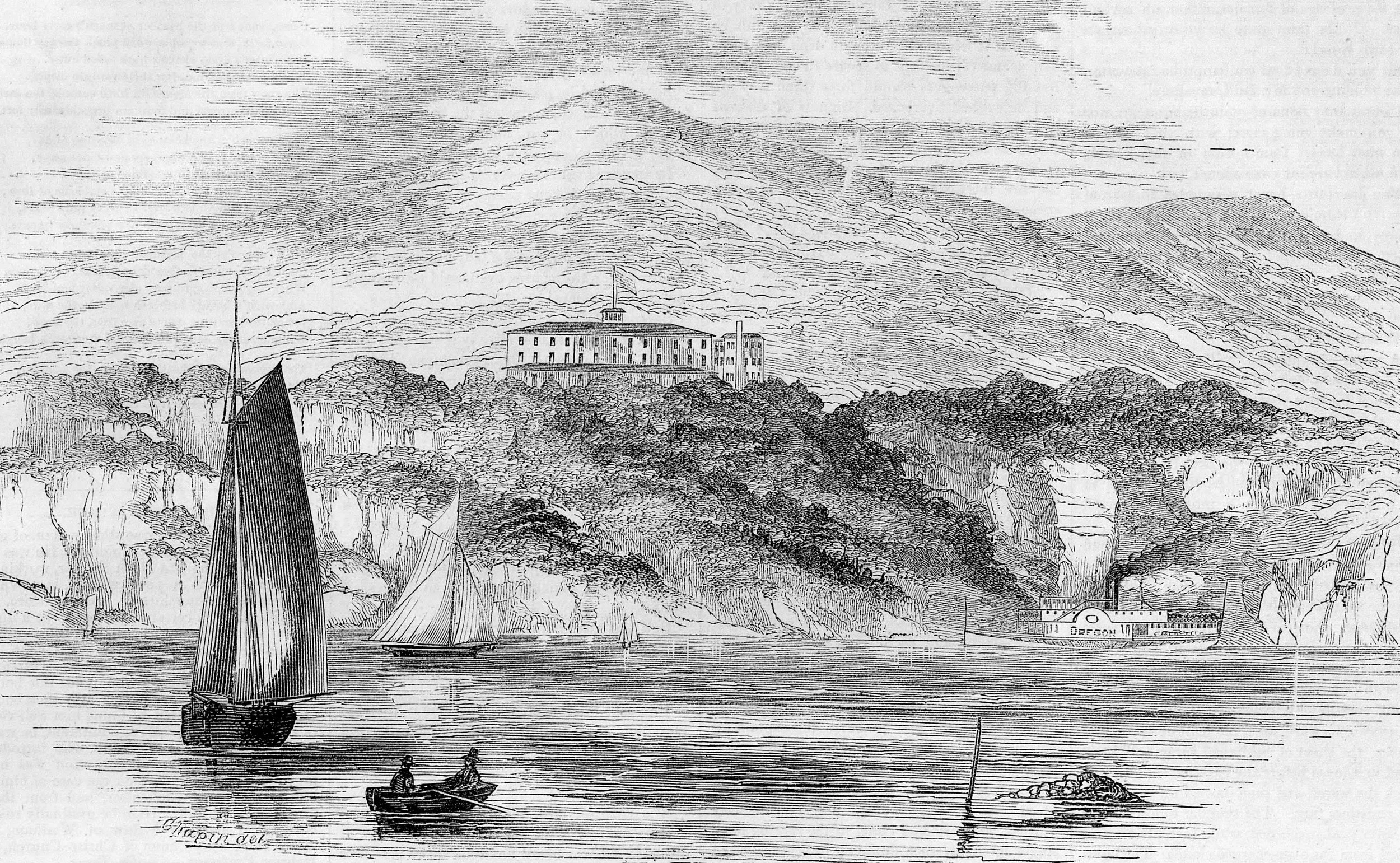
An 1852 engraving of Cozzens’ Hotel and Landing. This version of the establishment burned down in 1861 and was replaced. Source: Gleason’s Pictorial Drawing-Room Companion, II(18), May 1, 1852, 280.
Cozzens owned the dock, and, because the hotel was full of families and travelers, denied the group’s request to disembark, as was his normal policy. The captain docked anyway, and a mass of excursioners, possibly tipsy, stepped ashore. A muster of militiamen moved up the steep hill to the Hotel. Many of the military visitors, wearing “war’s grim dress,” continued on to a picnic on the Plain at West Point, but some of the party stayed behind and attempted to force themselves into the Hotel by way of its piazza. Guests and employees, including Cozzens, his son, and, by some accounts, his wife, repelled the violent militiamen. During the melee, the porch of the hotel collapsed, causing many involved to fall. The Alexandria Gazette reported that they were “precipitated into the basement below.” In the end, the New Jerseyans and guests were denied entry. At least one account reports that the incident occurred at 6:30 p.m..
The story hit newspapers across the country, though the accounts differed. The basic facts are fairly consistent, but some accounts were sensational. Here are some of the more dramatic bits in the press, which should be taken with a grain of salt:
“They therefore commenced an attack upon the house, and became very riotous; however, did not gain entrance, and in a short time were repulsed. Mr. Cozzen’s [sic] son had his jaw broken in the affray.”—Buffalo Courier Express, August 11, 1851.
Accounts vary on Cozzens-family injuries. In another account, Mr. Cozzens receives a musket to the face, breaking his jaw.
“Some state that a portion of the pleasure party were in the bar room drinking, and that slight offence offered to one of the bar- keepers caused the row--that all the servants, waiters, and a private party who had been enjoying themselves, in another part of the hotel, sallied forth and attacked the Jersey City folks with dirks [daggers], clubs, spittoons and chairs, and a general melee ensued, smashing up everything in the bar-room.”—The Charleston Daily Courier, August 13, 1851
“Another version of the affair is that the pleasure party were passing the hotel inoffensively, save that some of them had been a little merry from the effects of wine, and that the servants and private party in the hotel rushed upon them attacking them indiscriminately, with all sorts of weapons. One individual, who was on the excursion, but who states he did not witness the row, informed us that a boy and one woman are mortally wounded. Another, who says he saw the whole transaction, stated that as many as fifteen or twenty are seriously injured, and that he believes several of these will not recover.”—The Southern Press, Washington, D.C., August 13, 1851
“We are informed that an attempt was made to stab Justice Chambers, of Jersey City, and that Constable McManus threw himself between the antagonistic parties, when he received the dirk in his face, laying open the whole of his left cheek.”—The Charleston Daily Courier, August 13, 1851